
When a client gets off my table after a Functional Integration® (FI) session, the feedback that moves me most isn’t a clinical acknowledgement of being “fixed.” Instead, it is when someone pauses, takes a deep breath, and says, “I am feeling my body like never before,” or “I finally understand my pain, and for the first time, I know how to support myself.”
These revelations capture the true, unadulterated spirit of the Feldenkrais Method®. FI is fundamentally not a medical therapy designed to repair a broken biological mechanism; it is what Moshé Feldenkrais beautifully termed “an art of kinaesthetic communication.” My ultimate goal on the table is never to impose an external correction, but to provide an experience of learning that promotes a lasting takeaway for genuine, autonomous self-support.
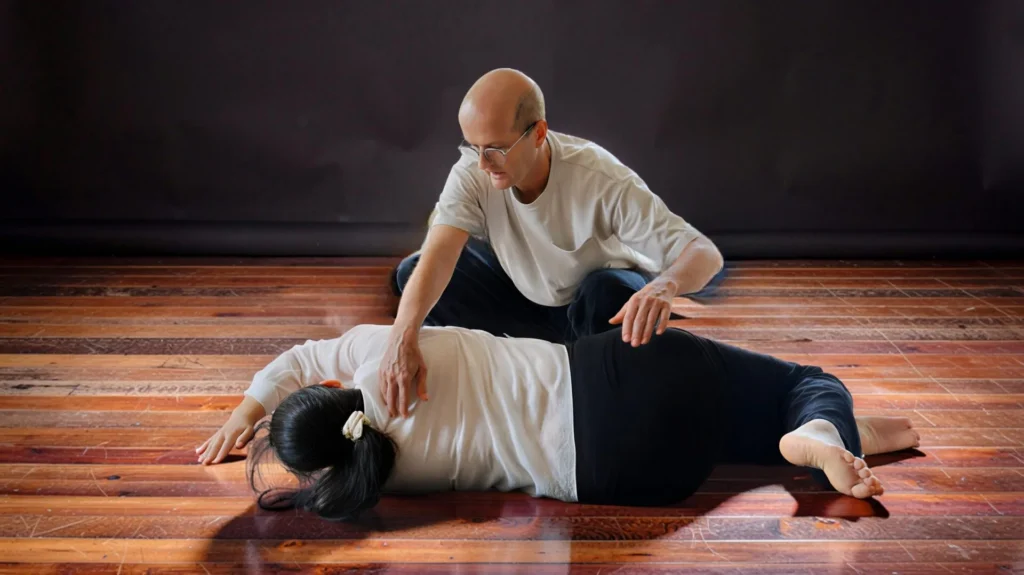
However, for my hands to communicate fluidly, a profound shift must happen within me first. Just as when giving a counselling session or an intuitive massage, a practitioner’s own mind must be entirely free from rigid, repetitive habits, clinical assumptions, or premature conclusions. If I approach the table with a fixed agenda, the dialogue is already compromised. This is precisely where a deep, continuous immersion in Awareness Through Movement® (ATM) becomes indispensable to my practice.
Practising ATM is never about repeating physical exercises to get them “right” or to achieve a superficial aesthetic standard. Instead, it is an invitation to refresh, play with, and awaken our own inner diversity within the safely structured frame of the lesson. It is very much like swimming freely in the open water space of a swimming pool. The walls of the pool provide the necessary boundaries—the lesson’s structure—but within those bounds, you are entirely free to glide, float, alter your trajectory, and explore the weightlessness of your own design.
When exploring movements within ATM lessons, understanding the underlying structure of the lesson is essential; it acts like the architectural frame of the swimming pool rather than the swimming performance itself. Deeply understanding this blueprint allows us to keep our brains from being preoccupied with figuring out the cognitive map. By shifting our focus away from navigating the territory, we stay entirely at the level of a fluid sensory dialogue—which is the only way to allow new happenings to occur, refreshing and reshaping personal organic behaviours.
Completely dropping the pressure to perform or achieve, and safe within the familiar layout, we finally begin to explore the subtle variations, the micro-adjustments, the texture of our breathing, and the unexpected pathways available to our skeleton. It keeps us from repeating the movement like a mechanical exercise, allowing us instead to jump into a familiar environment and welcome entirely new discoveries.
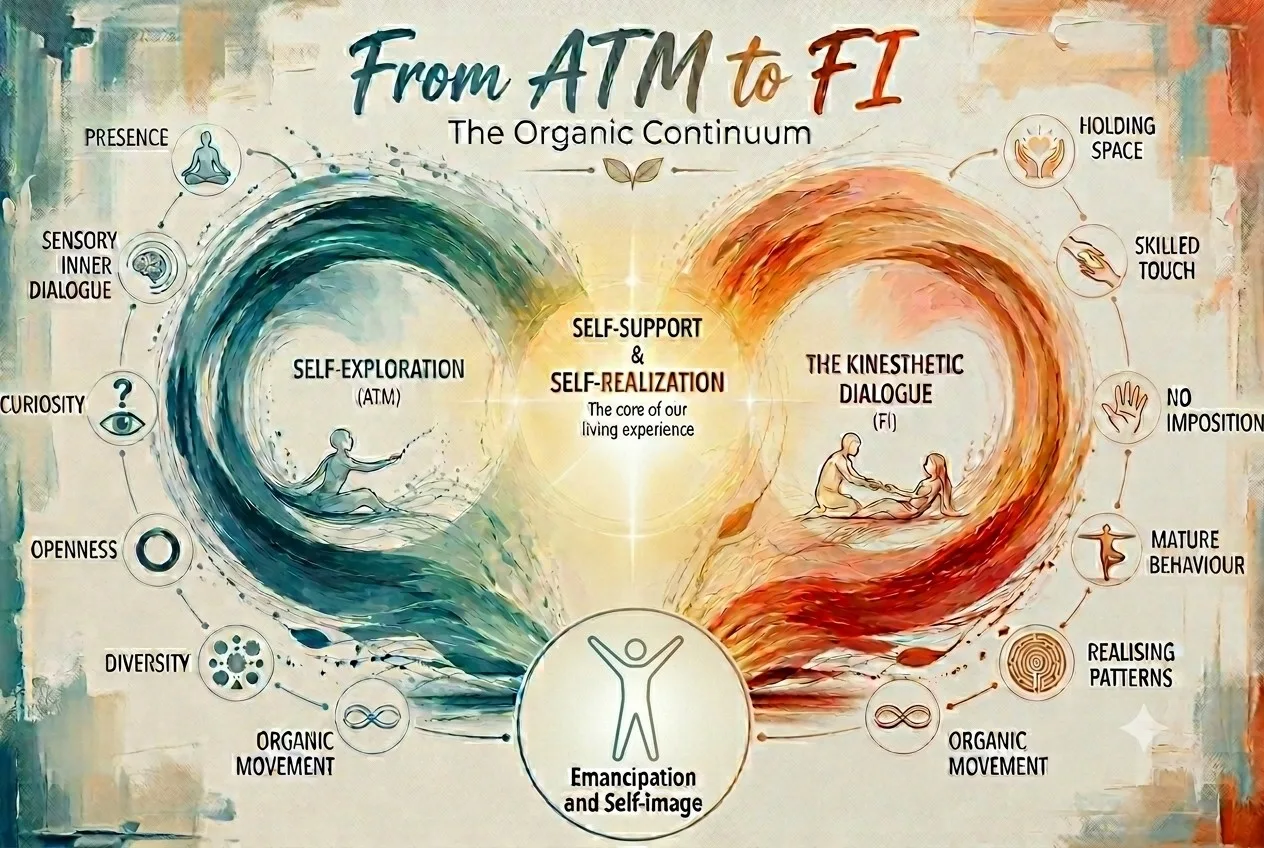
This is exactly why I always encourage my ATM students to practice and revisit the same lesson more than once. Repetition in the Feldenkrais Method© isn’t intended for building mechanical muscle memory or drilling a habit; it is cultivated for conversational depth. It is through fluidly revisiting a movement that true, embodied understanding emerges, accompanied by a profound openness of mind and a sudden spark of somatic creativity. We stop moving mechanically, leave behind the demand for automatic efficiency, and start moving organically, which naturally improves our everyday, real-world function.
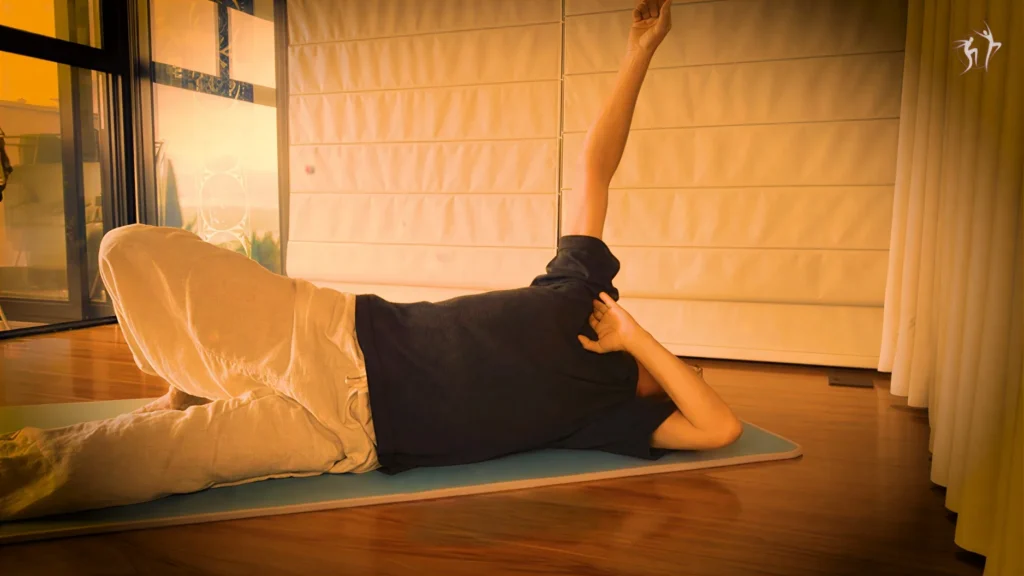
This creative openness directly reshapes how I work with a person during an individual FI session. If my personal repertoire consisted only of a few rigid protocols or fixed anatomical scripts, my touch would inevitably become a monologue—an instruction shouted at the client’s body. Because ATM continuously fills my mind with an expansive landscape of endless possibilities, my hands bring a rich, living, and highly adaptable vocabulary to the table.
Instead of imposing a forceful change from the outside, my touch simply offers their nervous system the gentle option of breaking chronic, limiting patterns. Providing unconditional space for self-realisation by the client is infinitely more powerful and enduring than any top-down instruction. To me, that is the true art of teaching.
When we step away from the role of the correcting therapist, we connect through a genuine, non-judgmental dialogue of movement. By exploring these endless variations together on the table without force, the client actively discovers unexpected paths to comfort. They don’t just leave with a temporary relief from discomfort; they walk out of the studio door holding the keys to their own self-realisation, fully capable of supporting themselves long after the session has ended.
不要忘记查看我们即将举行的活动和课程的日历。
Don’t forget to check the calendar of our upcoming events and classes.