
This was the question posed by a student to Moshé Feldenkrais during his 1975 training in San Francisco.
The question arose during a discussion on “Potency” (the power or potential for action). In Feldenkrais’s philosophy, “potency” is not about power over others, but rather the ability to mobilise one’s internal resources to act with clarity.
The student sought to understand how this individual “potency” connects with others and with society at large.
Here is Feldenkrais’s response:
“Responsibility means that the individual can organise his life so as to be comfortable without disturbing others, particularly the people he is close to. If he disturbs others, then slowly it becomes uncomfortable for himself. This is the responsibility of movement, responsibility of conditions. It is the responsibility of one’s health. It is the responsibility of everything that the individual does while he is alive. That is very difficult to do…
…So, potency, freshness — it is the same thing. A person who has the strength to stand for himself, to do what is necessary for himself in order to live without disturbing others… because if he disturbs those close to him, it makes it worse. If he has no strength, he better give up and do what analysis would do, what all psychoanalysts would do — adapt to the environment. That is, to dissipate and integrate into the environment, to become a vegetable, to adapt. There are some who understood that, like Maslow, and others who understood that to adapt is a weakness.”
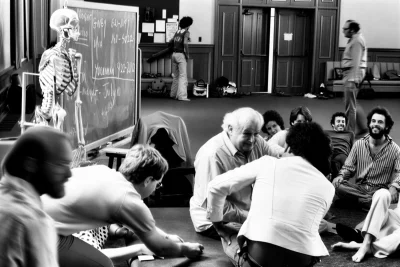
For Feldenkrais, responsibility is not a moral burden or a social obligation imposed from the outside; it is a biological and functional organisation of the individual.
He invites us to shift our paradigm:
In summary, being responsible means learning to organise oneself so effectively that one’s very existence becomes a positive contribution to those around us, rather than a burden.

不要忘记查看我们即将举行的活动和课程的日历。
Don’t forget to check the calendar of our upcoming events and classes.